How to Choose the Right Size Pendant Light
9 October 2026 · Pale Meridian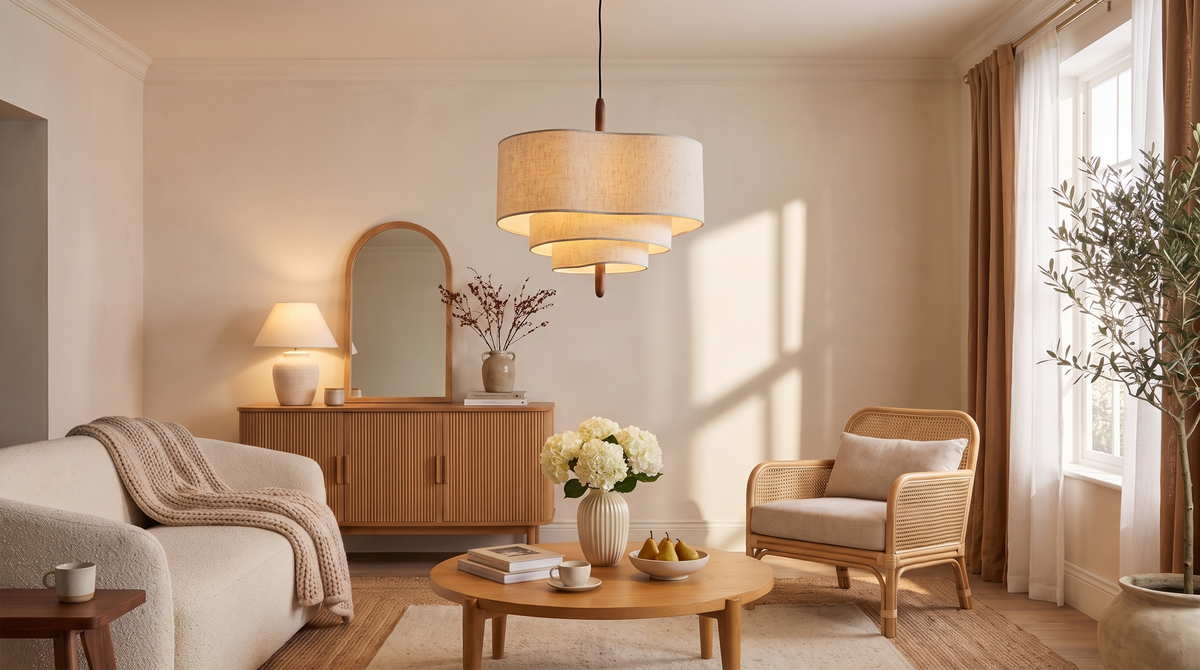
Most pendant light mistakes come down to two numbers: how wide the light is, and how low it hangs. Get those right and almost any style will look as if it belongs. Get them wrong and even a beautiful lamp looks lost, or crowds the room. Here are the rules of thumb we use, with some UK room sizes to make them easier to picture.
Start with the width
For a light that hangs in the middle of a room, here's a quick way to find a starting size. Add the room's length and width in metres, then multiply by 8. A living room that's 4m by 3.5m gives 7.5 × 8, so around 60cm across is a good starting point. It's not a law, just a way to avoid the two common mistakes, which are going too small and going too big.
Visual weight counts as much as width. A dense, solid shade of plaster or stone looks bigger than an open rice paper globe of the same diameter. A tiered linen shade sits somewhere in between, because the light glows through it. If your room is small or low-ceilinged, go a size down on anything solid, and a size up on anything airy.
Over a dining table
This is where pendants earn their keep, and it has the clearest rules.
Width: aim for the light to be about half to two thirds the width of the table, and keep at least 30cm of table showing on each side so nobody feels the shade is hanging over them. On a 90cm wide table, a 40 to 60cm pendant works well. Our rice paper globe pendant comes from 30 to 60cm, and our wabi-sabi dome pendant from 30 to 60cm, so both cover that range.
Height: the bottom of the shade usually sits 75 to 90cm above the tabletop. Lower it a little if the shade is open and you want a cosier feel, and raise it if you're tall or the shade is solid, because you need to see your guests across the table.

Hang it centred over the table, not the room. If the table is off-centre, the light should still follow the table. For a long table, use two or three smaller pendants in a row rather than one big one, with about 60 to 80cm between them.
Over a kitchen island
Islands follow the same logic as tables, but people stand and work here, so go a touch higher. Keep the bottom of the shade about 80 to 95cm above the worktop. Small lights look best in a row of two or three, evenly spaced, and each one shouldn't be wider than about a quarter of the island's length. Slim pieces like our travertine cylinder pendant were designed for exactly this, hung in a row at the same height.
In a living room
A central pendant is the hardest to place, because you walk around it. Two things help. Keep the lowest edge at least 2m above the floor if people will walk beneath it. And if it hangs over a coffee table or a reading corner where nobody walks, you can bring it lower so it feels part of the seating area.
On a standard 2.4m ceiling, that leaves little room for drop, so look for a shade that's wide rather than tall, and shorten the cord. The tiered linen pendant chandelier comes in 45, 58 and 70cm widths, and its three tiers add visual interest without making it much taller. Higher ceilings, from about 2.7m, give you more freedom to go for a taller piece.
In a hallway or over stairs
Entrances and stairwells can take a larger light than you'd expect, especially with a double-height space. The rule here is clearance. Walk the route a few times and check that nothing hangs below head height anywhere you'll pass, with extra room for someone carrying a box. A bigger shade also makes a hallway feel more welcoming, as it's the first thing you see when the door opens.

In a bedroom
Beside the bed, pendants work well in pairs, one on each side, hung so the bottom of each shade sits roughly 50 to 60cm above the bedside table. Small lights are better than large ones here, so look for a compact piece such as our stone cylinder bedside pendant, which is only 12cm wide.
A final check before you buy
Cut a circle from newspaper or cardboard at the width you're considering and hold it up where the light will hang. It takes a minute and tells you more than any formula. Live with it for a day or two, then adjust the height by a few centimetres until it feels right.
Not sure which size or style suits your room? Browse our pendant lighting collection for sizes and measurements on every listing, or read our guide to what Japandi really means for ideas on choosing a style. If you're planning a whole room, our next piece on warm white, lumens and kelvin will help you pick the bulb and layer the light.